Minggu pagi, Jenna – anak sulung saya yang baru TK kecil, meminta jatahnya menonton TV setelah semua ritual paginya selesai: mandi, makan, beres2 mainan, dan menggoda Isma – adiknya yang masih bayi.
Klak-klik saluran TV, ada 4 jenis kartun yang ditayangkan 4 stasiun televisi yang berbeda: Spongebob, Sinchan, Disney (Mickey Mouse dkk) tapi yang versi dulu, dan Pororo.
Terus terang untuk urusan TV saya lumaya tegas (atau berlebihan?). Dalam satu hari, Jenna dibatasi menonton 1 jam (maksimal 2 jam jika yang ditonton adalah video pembelajaran yang tersedia di rumah) dan itupun harus didampingi. Kalau ‘terpaksa’ memilih saluran TV, saya lengkapi dengan mainan (balok, gunting-lem, kertas, any edutoys)/ buku untuk pengalih perhatian ketika iklan.
Oke, kembali dengan pilihan yang tersedia tadi. Setelah beberapa pendampingan (ada juga film yang saya putuskan tidak layak tayang di rumah saya tanpa Jenna harus menonton dulu), akhirnya terdapat 3 pilihan film kartun tidak saya rekomendasikan untuk ditonton Jenna:
Spongebob. Komentar Jenna: “Jangan, Mi… Mister Crabnya pelit dan Squidword kata-katanya jelek.” Hehehe… Syukurlah. Saya sempat, dengan naifnya, memperbolehkan Jenna menonton kartun ini beberapa kali. Untung sempat saya dampingi. Sebenarnya itu adalah kartun dewasa dengan setting orang dewasa yang bekerja, semacam The Simpson. Lebih kaget lagi di episode terakhir yang sempat saya tonton, Squidword sempat berkata-kata kurang baik.. bukan kasar.. hanya saja membuat saya kuatir akan ditiru oleh Jenna. Selain itu, saya bersyukur Jenna berhenti menonton ini, terutama setelah terbit penelitian tentang anak-anak yang berkurang kemampuan mengingatnya setelah menonton film kartun berframe cepat semacam Spongebob.
Sinchan. Haduh.. maaf.. kalo yang ini saya sama sekali tidak memberi akses kepada Jenna. Saya katakan kepadanya kalau ini sebenarnya film kartun untuk orang dewasa. Namun berkat Sinchan juga Jenna akhirnya tahu kalau tidak semua kartun bisa dikonsumsi anak-anak.
Disney versi lama. Untuk yang ini, kami sempat dua-tiga kali menonton sampai ada adegan yang kurang pantas untuk anak-anak yaitu adegan pacaran dan berkelahi. Pada saat itu saya alihkan saja perhatian Jenna dengan mainan jika tidak ada siara pengganti atau saya tawarkan menonton koleksi film Pocoyo/ Syamil & Nadia/ Tupi&Pingping.
Dapat ditebak kan? Pororo-lah yang bisa mengambil hati kami (saya terutama) hehe.
We Love Pororo: The Little Penguin
Bagaimana tidak, dari pilihan kisahnya yang mendidik, kata-katanya yang sesuai untuk anak-anak, hingga lagu-lagunya yang tidak asal buat (saya saja ibunya bisa hapal lho.. hehehe). Potongan lirik lagu penutupnya saja – “Kami berteman baik” mampu membuat saya hapal (melodinya-walaupun liriknya salah ;P). Lagu ini juga pernah dibuat senjata oleh anak saya ketika ia harus mendamaikan dua temannya yang bertengkar.
Animasi Korea yang satu ini memang luar biasa. Mendunia karena kemampuannya menggaet perhatian anak-anak dan orang tuanya sekalian. Nah… kalau demam K-Pop yang ini saya sangat setuju! ^____^
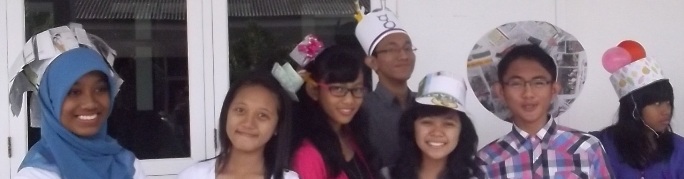
No worries, this kind of invasion only happens once a year and the impact is only for the good laugh for creativity made by the community in the school units.
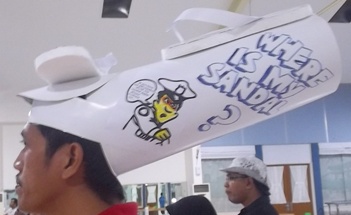
So, what is the hat attack? Um… originally named Creative Hat in on of the thematic Fridays in the Sugar Group Schools – a group of schools unit owned by the Sugar Group Companies. This post will review on the uniqueness of hat creations, ideas, even up to the interpretation of ‘creative hat’ itself. (Eh?)
Most of the students come up with creative ideas. Some student come up with an idea of creating hats using newspaper…
Marvelous Paper HatsThe JakPost AmbassadorMore Newspaphats
Not enough? Maybe adding some balloons will make it have a sense of.. um.. art? 😛
Ready to fly? 😛
Construction and thick papers will work the beauty. Check these ones:
Need a Rainbow, Ma'am?The Angry Bird AttackHat Paper BeautyThe Circus Hat
Or… if you have more time… maybe you can try the idea of this great spider straw hat (I gave two thumbs up for this one :D)
The Spidey Straw Hat
Some others have great ideas with flannel fabric…
Flannel hat that beautifies the owners ;P
See how it beautifies them? :P.
Ow… and check these cool hat ideas:
A hat that talksOther Hat IdeasIt's Cesarean Time!'Let's Go to Bank' HatLady Marmalade
And there are also some ‘interpretations’ of what hats should be… like these ones 😀
A reinterpretation of a hat (or a mask) ;PA Hatwig!
Phew… actually, I haven’t shown you all but I guess the tour has shown you the bottom line that creative ideas really do need creative (and crazy) people to apply it. I really enjoy the sight in every corner of the school though!
Hope that I will see crazier ideas in the next thematic friday!
Sungguh, aku terhenyak mendengarnya. Ibuku yang rela mencucurkan seluruh keringat dan air matanya untuk membuatku sebesar ini kini sendiri.
Aku yang katanya tahu bagaimana membalas budi hanya diam… diam… diam… Ia sendiri harus berjuang dengan sel-sel kanker yang menggerogoti tubuhnya. Sendiri…. dalam diam…
Omong kosong jika kukatakan aku pandai membalas budi! Dimana aku sekarang dan dimana wanita itu? Wanita yang rela melakukan nyaris apapun untuk membuatku seperti sekarang?
Kematian yang mendekat sedekat helaan napas yang memburunya telah membuatnya rela digerogoti keputus asaan. Ketiadaan orang-orang yang dicintanya membuatnya tak sanggup melangkah… tak berani bermimpi…
Ah Mama…
Semoga aku masih diberi waktu untuk bersamamu. Memelukmu. Mengingatkanmu bahwa ada aku…. yang mencintaimu…
“New semester means new groups in Englicious Class!”
“Yaaay!” murid-murid kelas 12 itu pun berseru gaduh. Haduuh… ko kelasku tidak seperti kelas 12 ya…
“Yaiyalah… liat aja gurunya!” Itu komentar rekan kerja saya sesama guru. Wew… ~____~”
Lalu, saya tawarkan murid-murid tercinta saya itu untuk membuat group sendiri dengan batasan bahwa dalam satu kelompok terdiri dari laki-laki dan perempuan.
Ajaibnya, mereka menolak lho! Berbeda dengan tahun lalu yang langsung iya-iya aja karena mereka memang ingin bergabung dengan kelompok bermainnya (geng maksudnya).
Tahun ini anak-anak menunjukkan wajah bingung ketika saya meminta mereka memilih sendiri anggota kelompoknya. (Haduuh.. bu Mierza… ingat2! setiap anak itu unik.. begitu juga tiap generasi!) Anggap saja tahun ini setiap kelas itu kompak, sehingga bingung mau dengan siapa….(terus berpikir positif J)
Baiklah.. putar otak…. akhirnya si jurus grouping pun dikeluarkan!
“Alright students…. Since you ask for it, I’m going to regroup you in a natural way.” (Halah! Natural way? Bingung habisnya mau ngomong apa.. hehe…)
“Please stand up and get ready to listen.”
Stop!
Ceritanya akan saya hentikan disini ya karena lamannya mungkin tidak akan cukup, berhubung saya mengajar 5 kelas yang berbeda. Yang pasti pengelompokkan tadi berjalan seru, menyenangkan, serta menegangkan dan mungkin bisa menjadi ide ice breaking juga.
Nah… Berikut 2 tipe grouping seru yang pernah saya lakukan di kelas.
A. Object Grouping
Object Grouping
(RE)Grouping yang satu ini hanya mengandalkan sisi auditory dan kinestetik siswa (dan mungkin gurunya juga, hehe). Dari object grouping, kita bisa mengelompokkan siswa menjadi pasangan atau kelompok bertiga, berempat, berlima, dst… dst.. tergantung kebutuhan.
Yang harus dilakukan pertama yaitu mengkomunikasikan apa yang harus dilakukan dan pastikan siswa mengerti. Jika dibutuhkan (dan biasanya diperlukan), guru ikut memperagakan objek yang dimaksud dengan variasi sesuai pribadi masing-masing tentunya. Namun, seperti yang dibilang murid-murid saya: semakin lebay semakin oke! Hehehe.
Peraturan lainn yang saya terapkan yaitu pada setiap perubahan gerakan, anak-anak harus memastikan bahwa anggota kelompoknya benar-benar baru! Ini untuk menghindari kelompok yang mencoba untuk terus bersama. Kalaupun ada anak yang ingin memolakan, silahkan.. mereka jadi terpacu untuk berpikir mengenai peluangnya kan. (Hehe… gotcha!)
Objek dan gerakan yang saya pilih lalu jelaskan kepada anak-anak adalah sebagai berikut:
Liberty Statue. Anak-anak diminta memperagakan patung liberty dengan satu tangan di atas berpura-pura memegang obor dan satu tangan lain memegang buku. Biasanya saya meminta anak-anak untuk memerankannya secara anggun (setelah saya peragakan tentunya J).
Welcome Statue. Kalau yang ini saya ambil dari patung selamat datang. Anak harus mencari teman berbeda jenis kelamin den memeragakan patung ini dengan seimbang. Biasanya saya lebih-lebihkan peragaannya sehingga anak-anak harus berdiri satu kaki, dengan satu tangan ke depan dan yang satu ke belakang. (Gambar menyusul deh…J)
Traffic light. Nah, kalau yang ini lebih mudah. Dengan mencari dua orang berbeda, anggota kelompok diminta berbaris. Yang paling depan jongkok, yang di tengah membungkuk, dan yang terakhir berdiri dengan posisi agak menjorok kedepan. (Iya..iya… gambar menyusul ya….)
Train. Untuk membentuk kelompok berisi empat orang, anak-anak diminta berbaris dengan tangan yang bergerak-gerak ke depan dan belakang persis seperti roda kereta api dengan siswa yang paling depan memperagakan masinis yang menarik tali untuk membunyikan… ng… apa ya namanya? Peluit? Yang bunyinya tuuut… tuuuut… Oya minta anak-anak membunyikannya juga… Huahahahaha.. seru deh pokonya.
Biasanya saya hanya membuat kelompok paling banyak berisi empat orang agar kerjanya efektif. Tapi kalau anda ingin membuat lebih.. silahkan cari ide lainnya. Yang pasti kegiatan ini sangat saya rekomendasikan.. terutama setelah istirahat makan siang. ^_____^.
B. Category grouping.
Kalau yang ini, kita harus menyiapkan kertas sejumlah anak yang mau kita bagi. Lalu, tentukan jumlah kelompoknya. Idenya banyak untuk grouping yang ini dan sangat bisa disesuaikan dengan pembelajaran. Biasanya, saya meminta anak untuk tidak memperlihatkan kertas yang dia dapat (atau malah saya minta lagi kertasnya hehe). Hal ini saya lakukan agar dia bisa ingat kata-kata yang dia dengar dan akan aktif mengucapkannya.
Category grouping yang pernah saya lakukan (dan yang saya ingat tentunya J):
1. Animal sound grouping. Ini seru… karena kelas anda akan berubah menjadi KANDANG!!! Hehehe… Pertama bagikan secara acak suara-suara binatang (kalau saya waktu itu ya suara binatang dalam bahasa Inggris): ruff-ruff (anjing), Meow (kucing), Oink-oink (babi), cockle-doodle-doo(ayam), dan quack-quack (bebek). Anda bisa membahas ini setelah mereka duduk dengan kelompoknya.
2. Parts of Speech sound grouping. Untuk pengelompokkan yang ini, karena tujuannya adalah grouping, maka anak-anak saya haruskan membawa kamus sehingga mereka tahu kelompok parts of speech-nya (haduh.. apa ya bahasa Indonesianya?). Sama dengan animal sound, pastikan anda sudah menyiapkannya. Contoh:
Nouns: classroom, toilet, tree, door
Verbs: leave, write, smile, try
Adjective : beautiful, great, enormous, terrible
Dst.. dst..
Grouping ini sangat bisa anda variasikan sesuai dengan pembelajaran jika terdapat pengelompokan-pengelompokan yang harus dihapalkan. Dari pengalaman saya, banyak anak (kinestetik terutama) yang terbantu untuk menghapal kategori yang memusingkan (misalkan pengarang dan buku-bukunya atau nama binatang langka dan habitatnya) dan terbukti mereka mampu memilahnya ketika saya membahas di akhir pengelompokkan. Biar anak-anak dulu yang mencoba mencari tahu. Sehingga tidak hanya disuapi (itu menurut saya loo…)
3. Pasangan peribahasa. Kalau yang ini ketika saya mengajar bahasa Indonesia di SD dan saya memang mau mereview peribahasa sekalian meminta anak duduk dan bekerja berpasangan. Caranya, siapkan sejumlah peribahasa yang harus dihapalkan anak. Jika memang hanya 5, misalnya, silahkan dikalikan hingga mencapai jumlah anak. Misalkan terdapat 20 anak di kelas,berarti ada 4 set peribahasa yang harus disiapkan. Lalu, potong peribahasa tersebut agar bisa dipasangkan. Contohnya peribahasa berikut adalah satu set yang ditulis di kertas terpisah: “Berakit-rakit ke hulu, berenang-renang ke tepian” dan “Bersakit-sakit dahulu, bersenang-senang kemudian”. Terakhir, jangan lupa acak set yang sudah disiapkan. Lagi-lagi… pengelompokkan ini juga bisa didesain untuk mata pelajaran apapun yang membutuhkan kemampuan anak untuk mampu memasangkan.
Satu hal yang harus selalu diingat adalah aturan main. Agar seru dan tidak menimbulkan ekses yang berlebihan, pastikan anak didik anda tahu apa yang harus dilakukan dan bagaimana melakukannya. Selain itu, saya selalu membuat kelas saya adalah panggung teater. Karena saya percaya :
“Teaching is 50% preparation and 50% theatre!” Hehehe…
Jika anda memiliki ide pengelompokkan yang lebih seru lagi jangan sungkan berbagi, ya!
On October 8, 2011, the rain would not stop 8 teachers and I to go to a seminar in Tanjung Karang. Even it was raining cats and dogs, we gathered in front of the Single Quarter (the lodgings provided by the company for single teachers or those having no child at the site) at five – not really punctual though, all of us departed 10 minutes afterward :P.
Okay…
We arrived at 7.50, 10 minutes earlier since the seminar started at eight. The committee welcomed us warmly. They even showed us the way to their canteen (maybe it was really shown that we were REALLY starving.. Hahaha! – “Come on, we departed at 5!” as we always defended ourselves :D)
About the seminar itself.
Since it was held in Sekolah Global Madani, an Islamic school, the first agenda after the opening speeches is Al Qur’an recitation. It was so amazing to see a high school student reciting it without reading.
Now… What we have been waiting for: MUNIF CHATIB *applause*
I do not remember exactly what he presented, but I always remember the 5 gifts teachers should give when she comes into a classroom.
1. To see that every child is a STAR
Every human is a masterpiece. Calling – or even thinking – names to be given to a child such as stupid, lazy, or any other names would only discourage them. Every child is born to be a star of their own…
2. To understand the OCEAN of their capacities
The slides show a turn-around pyramid. From the biggest to smallest space, it was written:
– Ahlaq – affective
– Creativity – psycho motor
– Cognitive
If we can combine them, not only focusing on the last smallest portion i.e. cognitive, we could have the best final result: THE BENEFIT
3. To find out the TREASURE in every child
He redefined the term INTELLIGENCE into HABIT. By creating activities that will provoke them to improve their CREATIVITY and PROBLEM SOLVING SKILLS.
He also put forward the danger of forcing students’ cognitive aspect. It will finally make their character and creativity to withdrawn and finally will create a COGNITIVE SHUT DOWN. We have to make sure, as a teacher, we give proper stimulus, in order to help them developing their competence.
What we have to bear in mind is that one’s intelligence is not related to their physical and brain conditions as well as the result of standardized tests. Yet, it is closely related to DISCOVERING ABILITY, THE PROPER PLACE, and BENEFIT.
4. DIVING to discover their ability
As educators, we have to train ourselves to find out their abilities, NOT heir inabilities. As what we have known before, there are 9 multiple intelligence. We have to be able to find out what intelligence surfaces from every child.
5. Find out their talent
Every child has a potential to have a talent. If one has found it, it could grow into a hobby, and developed into ability, which is supported by their interest, and finally could go more serious into their hobby.
Wow…
The way he packed the session is interesting. Especially at the time he used some videos of children whom we might think that they could go that far.
Well. actually we expected more from this seminar. We expect something applicative so we can share and apply it in the classroom. However, the school promise to hold a workshop on that one. After then… I have no more to say… Let’s see….
Reading Pak Marsudi W. Kisworo’s blog (he’s the Head of Perbanas) entitled “Guru yang Melahirkan Kehebatan (dari Rhenald Kasali)” reminds me to a national event held a couple of month ago: The Independence Day of Indonesia on 17 August 2011…
In this site, we celebrated it by starting the day with a flag ceremony. All employees of the companies – I live in a sugar cane site where all employees are provided housings and free education (How lucky we are!) – as well as the school communities gathered in a field.
One of the agenda is to announce the students with the best achievements. The first rank students- as they would call them literally translated. And there you go, one by one students were called by the announcers…
At a glance, I saw a wishful face of my students… wishing that they would be called as well. But that would not happen since the number of students called were even less that one percent. Some students might think that it would be such a fantasy to be appreciated like that. To be known to be the best… the best that they can be however.
It has been far too long that we put exaggerated priority on the cognitive level of the students. I professionally think – as an educator – instead of encouraging them, it would be the other way around. How about some students who are improved their interpersonal skill who do not face any difficulties in mingling with anyone. Or the ones who have a strong character that they could be the a promising leader. Why don’t we also put them in the “rank”?
How long will we be trapped in this “ranking system” that only creates more and more problems in maintaining characters? We have been through some years in which cheating is considered not special anymore in facing the national exam. How could we build better generations if this continues to happen?
The questions.. I bet… should be answered by myself. I should continue my fight to put forward this case… against the ranked school report. So that the future generations can be well acknowledged more than their brain to be the best in the class room, but to be the best that they can be.
Welcome the new generation of Ibu Mierza’s Englicious Students 2011-2012! Yup… We are starting fresh and rejuvenated in this delicious English classroom. We’re not going to only to prepare you to be the best that you can be in using English, but also to have fun with it.
The main topic for the first semester will be about the Glocal Poverty Issues happening around us. The appetizer is on the introduction to Glocal Poverty itself by being in it through a theatrical performance. Afterward, I invite you to investigate the causes and effects of Glocal Poverty and result a sequences based on your own analysis. And finally, the semester will end with the fascinating desert of your rebuttal opinions and arguments on what YOU can do to overcome poverty (I personally never believe in the word ABOLISH POVERTY).
As for the second semester, at a glance, I will show you that preparing for the next step to your future – a.k.a. The National Exam – can be also as delicious as dining itself. We’re going to cherish every moment of it and make it as wonderful as we can… in our very own Englicious Classroom. Hopefully you are patient enough in waiting for it to happen.
Well, happy tasting the deli of English and tell the world – through your blog – that you are the Glocal Generation!
Now we are starting fresh and getting ready to be rejuvenated in the classroom. The main topic (as always) will be the glocal issues happening around us. This year, we will deal with our own way of Perceiving the World Differently through topic of Global Poverty, as well as to find out our role in maintaining Environmental Sustainability through the issue of Global Warming (Between Myth and Reality), and of course – since this class will face the what is so-called National Exam, the final menu on the list is Preparing for the Future that mostly will deal with types of texts and expressions.
The things we cover will most likely be as follow:
Expressions for : suggesting, begging, complaining, discussing possibilities to do something, giving commands, acknowledging one’s fault, promises, blaming, expressing curiosity, stating stances, persuading, suggesting, criticizing, giving expectation, reminding, showing regrets, making plans, stating purpose and aim, giving prediction, speculating, and giving opinion.
Types of text: narrative, explanation, discussion, and review.
All the things that most likely will appear in the National Exam.
Well, happy tasting the deli of English and tell the world – through your blog – that you are the Glocal Generation!








Anda harus log masuk untuk menerbitkan komentar.